
AI-Based Vehicle Body Surface Inspection System
Automated Full-Body Surface Inspection Using Machine Vision, Artificial Intelligence, and Advanced Image Processing
Vehicle body surface quality control is a critical stage in the automotive manufacturing process. Cosmetic and surface defects can affect the quality of the final product and, if left undetected, may remain present through the final stages of production.
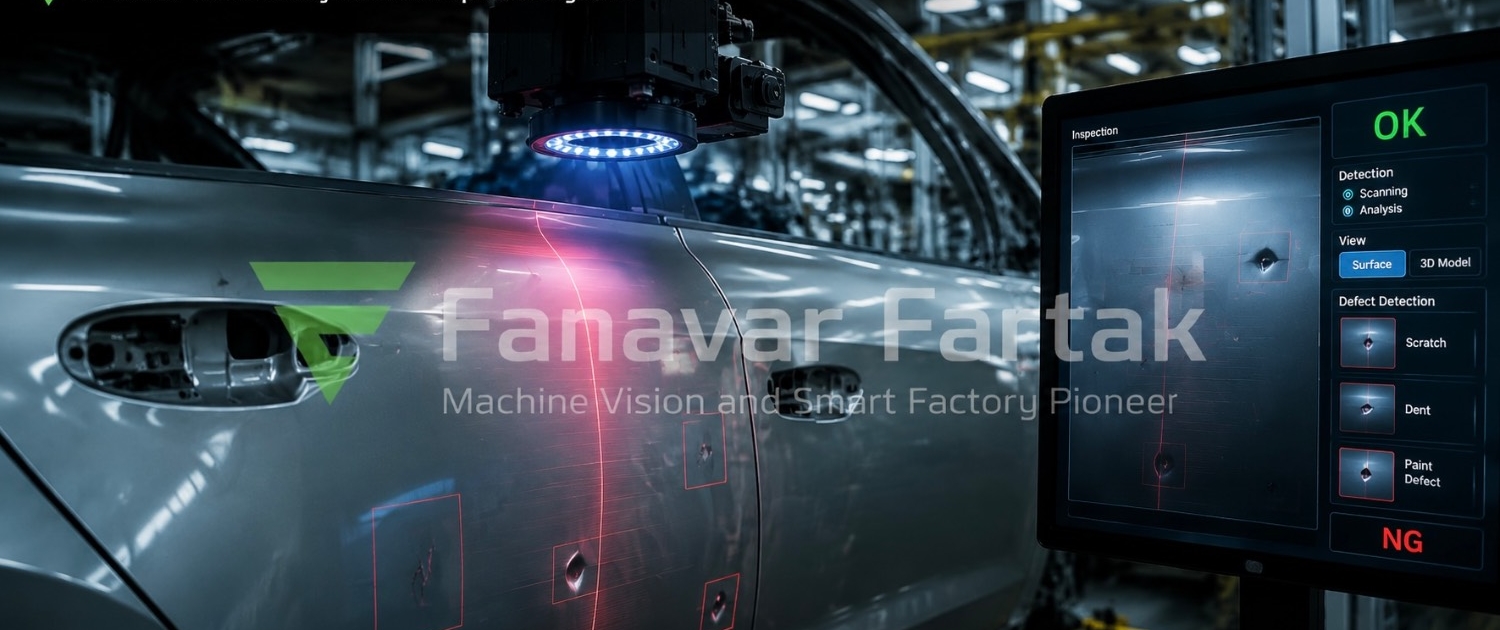
Fanavar Fartak’s AI-Based Vehicle Body Surface Inspection System utilizes Machine Vision, Artificial Intelligence, Advanced Image Processing, and Industrial Imaging to perform automated inspection of the entire vehicle body surface.
By capturing images of different areas of the vehicle body, the system inspects the surface and enables the detection and localization of surface defects.
Fanavar Fartak Solution
The AI-Based Vehicle Body Surface Inspection System uses industrial cameras, imaging systems, and controlled illumination to inspect different areas of the complete vehicle body.
The captured images are analyzed using image processing and Artificial Intelligence algorithms to identify areas with surface anomalies.
Once a defect is detected, its location on the vehicle body is determined, and the corresponding inspection data can be used in the quality control process.
The Challenge
Vehicle body surfaces feature complex geometries, multiple curvatures, and painted, reflective surfaces. These characteristics make consistent inspection of all body areas difficult using conventional visual inspection methods.
Manual inspection quality can also be affected by environmental conditions, viewing angle, lighting conditions, and operator limitations.
An automated system for uniform inspection of the complete vehicle body can therefore make the quality control process more repeatable and better documented.
System Benefits
Complete Vehicle Body Inspection
Enables inspection of different body surface areas within a single integrated inspection system.
Reduced Dependence on Visual Inspection
The automated system reduces reliance on purely visual evaluation by human operators during the quality control process.
Consistent and Repeatable Quality Control
Inspection is performed according to defined criteria, enabling a more consistent and repeatable vehicle body evaluation process.
Defect Detection and Localization
In addition to detecting defects, the system determines their locations on the vehicle body, facilitating subsequent inspection and corrective action.
Digital Inspection Documentation
Inspection images and results can be recorded and used for product quality control and documentation.
Main System Specifications
- Complete vehicle body surface inspection
- Automated, non-contact inspection
- Imaging of different vehicle body areas
- Automated surface defect detection
- Defect localization
- Image recording of detected defects
- Digital logging of inspection results
System Capabilities
- Automated inspection of the complete vehicle body surface
- Imaging of different vehicle body areas
- Surface defect detection
- Surface scratch detection
- Detection of body surface dents
- Detection of visual surface anomalies
- Defect localization on the vehicle body
- Image capture of defective areas
- Recording and documentation of inspection results
- Non-contact inspection
Applications and Target Market
- Automotive Manufacturers
- Vehicle Body Manufacturing Lines
- Automotive Paint Shops
- Final Vehicle Quality Inspection Lines
This system is designed for complete vehicle body surface inspection and can be deployed in automotive quality control operations.
System Innovation
One of the main challenges in vehicle body quality control is the uniform inspection of large, curved, painted, and reflective surfaces.
By integrating industrial imaging, controlled illumination, image processing, and Artificial Intelligence, this system enables automated inspection of different areas of the complete vehicle body within a single integrated process.
Defect detection and localization can also facilitate the subsequent review and correction of defective areas by the quality control team.
 Phone :
  Phone :
  Email :